
Same Hook, Different Road
Kern County roads run from quiet agricultural lanes to dense commercial corridors. The mix brings towing calls that look very different from each other at arrival. Our Lamont towing team works this full range. In-town and local calls reward fast spatial reading. The crew assesses overhead clearance, staging space, and approach angle before any rigging begins.
Close-quarters work asks a lot from the operator. Parked vehicles, low overheads, tight driveways, and heavy local traffic all define the environment. A compact wheel-lift suited for a neighborhood call is not the same setup needed for an open highway shoulder. Building that spatial read quickly is how city calls get handled without unnecessary delays.
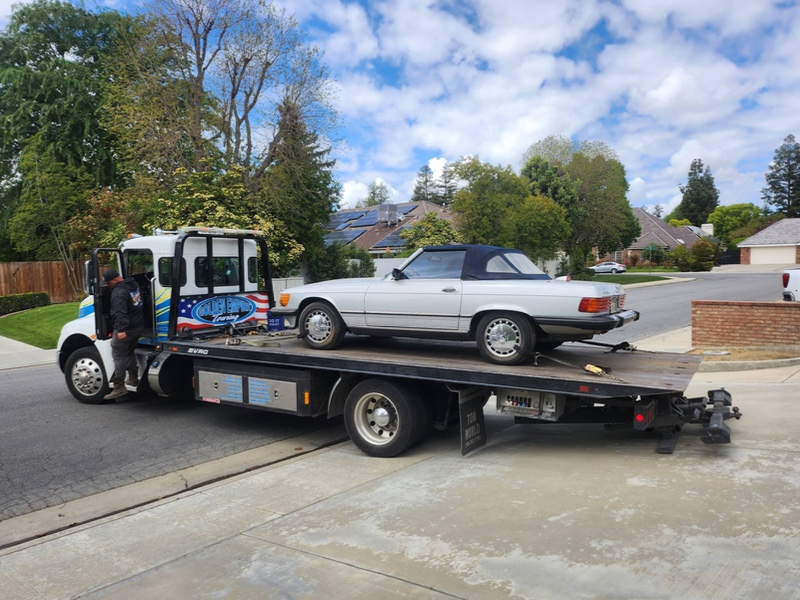
How the Crew Reads an Urban Scene Before Rigging Starts
Approach geometry matters more on a city call than on a highway. The crew identifies staging space, overhead restrictions, and exit path before positioning the truck. A commercial parking structure carries different constraints than a wide suburban lot. That scene read shapes every step that follows.
A Car on a Rural Access Road vs. One in a Commercial Zone
A car stuck on an agricultural lane and one in a strip mall lot call for very different setups. Soft terrain, limited access points, and poor lighting change what equipment is appropriate. Our Lamont towing operators carry the right rigging for both. The vehicle’s surroundings determine the plan before the vehicle’s condition does.
Highway and Corridor Calls Shift the Stakes
Active interstate corridors and state routes running at speed create immediate exposure. Scene control is the first job on any highway call. Lights go up, the truck positions as a buffer, and a work zone is established before the operator steps out. Moving traffic stays just feet from the crew throughout.
Equipment requirements scale up on highway calls. Commercial breakdowns, rollovers, and load shifts on active corridors require flatbeds, rotators, and heavy wrecker configurations. Our Lamont towing dispatchers confirm vehicle type, road type, and incident details before assigning a unit. Sending the wrong rig costs time and can leave a crew working beyond their equipment’s limits.
City vs. Highway: What Each Road Type Requires
Here is how the two environments typically break down:
- Highway calls require warning lights and a scene buffer before any rigging starts
- Active corridors need rotators, flatbeds, and heavy wreckers for commercial incidents
- Highway scene control includes lane management before any operator exposure
- In-town calls need compact, maneuverable units for tight access points
- Local road scenes require overhead, approach, and terrain assessment on arrival
- Every Lamont towing call is staged before departure to match the environment
Golden Empire Towing: Lamont Towing Built for Every Road Type
Golden Empire Towing has operated since 1993, starting with one truck and growing to a fleet of 45. The range covers light-duty towing, heavy-duty recoveries, 4×4 off-road extractions, rotator work, and load shifts. Partnerships with Bakersfield PD, Kern County Sheriff, CHP, and CalTrans put this team on the roads that matter most. Lamont towing calls are answered 24/7 by a family-owned operation that picks up the phone directly.
Every Lamont towing call gets the same preparation: right equipment, correct dispatch, operators who know the terrain. Every Lamont towing call gets the same response: right equipment, correct dispatch, operators who know the terrain. That is how the “Little or Big, We’ll Get Your Rig” standard holds every day.
FAQ
What is a rotator tow truck and when is it used?
A rotator is a heavy-duty recovery truck with a boom that pivots a full 360 degrees. It is used when a straight-line approach to the disabled vehicle is not possible, when the vehicle has rolled or gone off a steep embankment, or when surrounding obstacles prevent standard wrecker alignment. The rotating boom allows the operator to apply lifting force from almost any position around the stuck vehicle.
What does 4×4 recovery involve that standard towing does not?
4×4 recovery sends equipment off paved or accessible surfaces to reach vehicles stuck in soft terrain, muddy fields, or rugged off-road conditions. It requires recovery-grade winches, high-clearance vehicles, and operators trained to assess soft terrain, slope angles, and anchor points before rigging. Standard flatbeds and wheel-lifts are designed for paved surfaces and cannot access many of the locations 4×4 recovery handles.
What is a load shift and how is it handled on a highway call?
A load shift happens when cargo inside a trailer moves during transit, changing the vehicle’s weight distribution. This can make the truck unsafe to drive or cause it to lean. The towing company must assess the load, reposition or secure the cargo before moving the vehicle, and confirm stability before transport. In some cases the cargo needs to be partially offloaded first, which requires equipment beyond a standard tow.
What should I do if my vehicle breaks down on a state highway or interstate?
Pull as far right as possible. Turn on hazard lights. Stay inside with your seatbelt on until help arrives. Call 911 for any injuries or immediate hazards. Then call a towing company with your exact location, direction of travel, and a description of the incident. Do not stand between your vehicle and moving traffic while waiting.
What types of vehicles require a heavy-duty tow rather than a standard call?
Commercial trucks, semis, buses, RVs, large construction equipment, and any vehicle exceeding standard towing weight limits require heavy-duty equipment. These vehicles need boom, cradle, or rotator configurations that go beyond what a flatbed or wheel-lift carries. Heavy-duty calls also require operators with specific training and certification in load dynamics and recovery rigging for large vehicles.